Showing posts with label happiness. Show all posts

Tuesday, July 19, 2011

Failures as stepping stones

I know one thing for sure, I do not determine the success or failure of the things I am engaged in. Though I would desire success in all that I do, I do not succeed in achieving it; I am not able to say if there is something basically lacking in me, or if I am expecting far too much from life. I do have a good share of success in life, and for that I would ever be grateful to God; there were times when my companions and friends had envied me, and I had floated in vain glory. I even thought that I was smarter than what I had been imagining myself to be, or what others had thought me to be. But at the end of the day, I cannot help but admit that I am a mixture of success and failures in life, and I cannot hold on only to successes, for the real stepping stones in life are failures.

The world around me insists that success in life is the yardstick to measure the worth of life, but if that be the case a good majority of the human population would be condemned to failure in life, because what they had managed to achieve in life in terms of success are too negligible to mention. I know that success alone cannot be the indicator of how I have fared in life; I need to look for some other objective criteria, which will help me to assess my own self and that of others. Unfortunately the whole world may shout in unison that I was a utter failure in life and had not scored well in the examination of life, even if I had done my best. But I know with God there is a different kind of yardstick, and here he would look at my efforts and not so much the fruits of my labor.

Everyone around me looks at the fruits of my labor, if they are sweet or sour. There is not a single soul who would appreciate sour, but everyone would go in unison for the sweet. But the sour moments alone help a person to appreciate the beauty and wonder of the sweet. I had been overly conscious of achieving success in life, and in the meantime had failed to live life as it came to me with all its innumerable hues and colors. I had failed miserably to taste what life offered me, and even if I had succeeded in life from the point of view of the world, I have failed miserably before the Lord and before my own inner self. I had resisted the moments of my failure and cursed everyone who had made me fail in life, because it came as a bitter moment for me; it would take a life time for me to understand the secret behind every failure I had walked through.

If every single person were to succeed in life, and does not experience failure, then life would be quite different. It is only because there are failures that we could strive towards success, but there are moments when we find it hard to rise up from the fall and continue further in life. There are the moments we long for a helping hand, and who else but God stretches out his hand on the Cross and helps us to hold on to the wooden frame which is the ultimate symbol of failure. If the Son of God had gone through the ultimate symbol of failure, what is there for me to accept miniscule minute failures, which may not even leave behind their traces in my life. It is the crucified Lord who accepted joyfully the shame of utter failure, which could give me the sight to see the wonder of embracing failures when they come my way!

There is nothing more shocking and embarrassing for me than the moment of failures; this is the most unwanted reality in my life, and in fact there is not a single soul on earth, who would willingly and joyfully welcome failure. This is the unwelcome friend who alone can help us understand and appreciate the hard way to face reality. Today I stand to welcome every failure which may come knocking at my door, because it is only when I embrace it joyfully that I can enter into the very mystery of the Cross, and then I may find my way to the mystery of the resurrection, a success which may far surpass anything I could ever think of. This perhaps is the way of the kenosis, the self-emptying love of the Lord for his people. If I want to partake of the paschal mystery, then there is no other way than the path of failures, shame, scandal and humiliation which the crucified Lord walked through. Today this could be my way too to find fulfillment and true joy in life.

Monday, April 18, 2011

Why me, Lord?

One of my favorite songs of the yesteryears, was Why me, Lord! I remember listening to this song some 25 years ago, and the lyrics of the song still stir my heart. This song presents the popular sentiments of all people of all times, namely why should people suffer for no fault of their own. Yesterday as I was talking to a senior Sister, who had a fall and had to be transferred to another place, partially terminating her new assignment just half way through. I had been nursing positive hopes about what I could do, and all of a sudden my fall had changed all my hopes. What have I done to deserve this punishment, she asked me. I did not find adequate words to console her, and I remember three years ago, when I received the sudden heart attack of my brother in law and the immediate death, I did not know how to console my sister.

On many occasions we look up to God and raise the same question – why me? Of all the people on the face of the earth, why should I be subjected to such a harsh punishment? Could the Lord not have averted this thing happening to me? The Shack tried to delve deep into the mystery of this question, as did Job in the Old Testament. I know one thing for sure, this is a question that no human mind can adequately answer, and that is why human suffering and death are the riddles which cannot be conceived by the human mind. These are the realities that seal us with the imprint of humanness, and yet we yearn for an answer; we all want to know why bad things happen to good people. Human mind which has unraveled so many mysteries of the universe is unable to find an answer to this simple question, and it continues to baffle generations.

We are used to thinking only about ourselves, our own worries and troubles, and cannot think of anything beyond them. We think that only we carry insurmountable burden, while all others are enjoying their lives. This is because we do not easily disclose to others the mental pain and agony that we go through in life; we keep them locked up within our closets, or like to push them under the carpet. We all like to suffer silently, and that is the reason why each one thinks he or she is the only sufferer in the whole world; if only look carefully how each one is laden with heavy burdens, then we might think that ours is a much easier load than others. In fact every other person on earth is carrying much more burden than we do, and this could be a matter of consolation that we have been spared from such an insurmountable load.

It is impossible for us to imagine the greater plan that God may have for us, within which these painful moments, agonizing turn of events and unexpected change of our life expectations fall. Who can discern God’s way; it would be impossible for us to decipher the reason why things happen to us the way they do; if only we are able to find answer to all our questions, then the world would be quite different, and this time not necessarily for better. Thank God we are not able to understand why certain things happen to us; in most cases, we might thank God for making certain painful moments come our way, because these moments might have done more good to us than pain. However we could say this only on hind sight and it is impossible for us to recognize what the Lord has in store for us, when they do take place.

I cannot think of anyone who is spared of bad things in life; even the most virtuous and pious of men and women also had their own share of pain and suffering, sometimes these had more than their due share. This is because they had the mental stamina and spiritual vitality to bear all pain and suffering. In many cases, these men and women were subjected to more painful mental agony and torture, which tried to drain them out of the spiritual energy they had been relying on. All of us have our share of pain and suffering, and once we begin to see that it is only through the path of these painful moments that we could really enter into a state of sheer bliss. There is no shortcut to happiness and unending joy; we need to go through the path of pain and suffering in order to enjoy and relish what is in store for us. The wait might be worth it all.

Thursday, April 14, 2011

Letting Go

To tie and untie the rope that is tied to the shore from a boat is an art, and it is only those who know how and where to tie the rope, that can sure the safety for the boat and the people who may travel. It is an art to let things go, and it might require quite an amount of learning that goes along with this art, just like every art needs to be cultivated. The best example I can think of for letting things go, is the art of swimming. It requires quite a bit of courage to jump for the first time into a tank or a pool; we should be happy if there is someone who is at our side to help us teach how to place our strides, and I had learned to swim all by myself, and at one moment even felt sinking, and had not the voice or courage to call friends who were swimming at a little distance. But luckily I managed to float and since then I know I cannot sink in water. Then the few moments of sinking was agonizing.

If one is too frightened of sinking, one may never learn to swim. The same logic also applies for those who learn driving a vehicle, either two wheelers or four wheelers. If one is too frightened of meeting with an accident, one would never dare to take the vehicle on the road; there would be something preventing that person from daring. What I would like to point to is the experience of the freedom and ease that dawns after we take the leap, to borrow a term from the existentialist philosophers. In order to experience the freedom and the ease that follows the leap, the risk is worth taking. Worries and anxieties are blocks which prevent us from experiencing the freedom and ease which is our due, but these also present to us a sense of false security, and we might cling on to them hoping they would last long. The mind can scarcely think that true freedom is in letting things go, rather than holding on to them.

The false sense of security that worries and anxieties present to us is also linked to our own existence, and we cannot think of anyone who would allow ourselves to be annihilated. We all want to live, and we believe, though erroneously, that we could live only by holding on the things we hope will keep us safe and secure. But relying on worries and anxieties is like chasing mirages, and ultimately we might land up nowhere, or might find ourselves in the same place. To let go of things is daring to take the risk, and be prepared to face whatever that might happen to us, during the moments which follow the letting go. It is a very brief moment, but very crucial, because it is during these moments that the human mind may present black as white and white as black; if we are carried away too easily by the mind, then we might not reach the other shore, we may never learn to drive.

Let me explain why worries and anxieties present to us only a sense of false security. We know only too well that worries and anxieties are related to what is yet to come, and in most cases they are only hypothetical cases, because if we know certain thing for sure, then we do not worry about them, but if there is something not known to us may take place, that sucks our energy, and at the end we are more tensed imagining what could possibly happen. The clinging to worries and anxieties is nothing but a pigment of our imagination, and there is not an iota of truth and real security. Let me also face the other side of the coin : is it possible that my life may be endangered if I let things go free? Human experience has shown that that happens but very rarely, and we may not experience such things in our lives.

In fact, worries and anxieties do not allow us to take a step forward; they are oriented towards keeping us bound to the shore, hoping one day the other shore might exchange place with this one. There is nothing potentially dangerous with worries and anxieties, but they could become cause of one’s diseases, especially those relating to the heart, food habits, allergies and mental stress and tension. This is also related to a realistic self-assessment, so that we do not assess ourselves either as too simple or as too grand. Worries and anxieties rely on the qualities and securities which do not happen in reality, they are only in the imaginative and possibility domain. Too much of calculation and estimates might not work well with letting things go free, but we may have to make decisions on the basis of reality, and act upon them instantaneously.

Saturday, November 6, 2010

Joy of Being

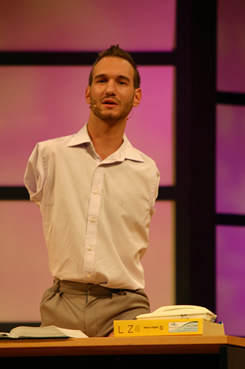
While watching a nine-minute long video of Nick Vijicic talking about what he has got, instead of being worried about what he did not have, I realized that he was touching upon something which is the root cause of all the evils in the world. With no hands and no legs, Nick is 23, and still growing strong, and goes around the world motivating people. Not having legs and hands did not deter him from venturing into areas which are unthinkable for such a person. He plays polo, swims, goes for skiing, and engages in real-estate business. He does all these without depending on the legs and hands he does not have. Wow, I said to myself!

If Nick is able to achieve so much in life, he attributed the success in life to three simple principles: perspective, vision and choices! His life is an illustration of how he turned the perspective of life topsy-turvy in order cultivate an habit of focusing his attention to what he could do, instead of what he could not. I am worried about what I do not have, and therefore make frantic attempts to get the objects of my desire, and in the process may not even bother about how this could affect others, either positively or negatively; my sole aim is to get what I do not have! I fail to notice the numerous things which have potentiality to produce some of the most noteworthy things… but I am obsessed with what I do not have.

In the recent days, I am becoming more and more aware that no one on this beautiful earth is poor enough that he/she has to look for something more to lead a happy and contended life. Not even the worst of beggars need anything more for happy life. It is only when I tell myself that my happiness is in HAVING something, that I begin to feel sad for not having it. In other words, if I link my happiness to having a thing, or a person close to me, or adulations and admirations, then when I do not get them, I am bound to be drowned in unhappiness. But there is yet another level where we could be always happy, by being content with my BEING, with all that it implies: the good health I enjoy, the still pure air I breathe, my sensitivity to colors, taste, touch, to name a few.

If there is evil in the world, it is because we have not learned to be happy with what we have, what we are; our mind is obsessed with accumulating more and more, without realizing that each of us have enough and more to survive perhaps at least two life-time. If I tell that I shall be happy with what I have, then I shall not need to cheat or rob others; I will not need to tell lies, I shall not need to kill others to take their properties. Nick had understood the significance of this truth, through hard way, and he knows he is talking about of hard facts which stared in front of his eyes. Once we realize that our happiness is not in having more things, but in enjoying our being, then we begin to live.

The human body, mind and spirit have enough potential to destroy the whole world entirely, or recreate it altogether. It is not merely the physical or mental or psychic power I am talking about, but also a spiritual power which can fuel the world to better the life we live. Today when I have a desire to have something more than what I already have, I shall convince my inner self that I will be happy with what I have, and therefore shall not look for anything more. I hope one day I shall get into the habit of foregoing the fabulous things that the world offers, and find delight and happiness in the little things that I have and treasure. Link for YouTube video : http://www.youtube.com/watch?v=6bL3GR4iAW0

Sunday, August 1, 2010

Nursing Parents’ Wounds

It is quite disheartening to even imagine that parents after about twenty years of blissful marital life could think of separation; whatever be the cause of family discord, it is hard to think of a situation where the couple feel quite incompatible, even after the two girl children, both of them quite grown up. At a time when the elder daughter is old enough to become a mother herself, it is next to impossible for her to think that her parents were contemplating seriously about separation, and she herself would do anything to stop that happening, but then she feels that she is helpless, at least in this situation.

Which child would think of his or her parents being separated; the modern world has seen many such cases, where the children are asked by the court to choose with which parent he/she would like to live, but as everyone is aware it is not possible to make a decision, that a child would live with the father or the mother. A child’s heart is too tender and soft to be torn apart by two parties. Granted that the two girls are grown up, that is not the reason for the parents to think of separation, and it is doubtful if the couple had exhausted all the possibilities of keeping the light of their marital bliss alive and blazing.

Parents are expected to nurse the wounds of their growing children, to stand by their side when the storms of life shake them from the root, but here is a situation where the children are called in to nurse the wounds of the parents, and the children just beginning to see the true color of the world are forced to witness yet another harsh reality of life, and they could hardly accept which looms before them. But would the parents who had been having stormy sessions on regular intervals down the years, think of giving another chance to the spouse to amend and get the family ties going? If the personal peace and happiness is what matters most to the couple, then it would have been better if they had not married at all!

For the elder daughter, who had offered her life to the Lord, it is more than her share of suffering the Lord had given to her, and every time she remembered the situation back at home, her eyes are filled with tears, but is it possible to leave behind the family, parents and the relationships and concentrate on her own personal call! As an individual who had grown nourishing the love and care of the parents, she feels she cannot afford to let this thing happen to her parents, but she is also aware of the crude reality, which reminds her, what if they do not care to listen to her plea! She would not have any one to appeal to!

It is not that my parents have peaceful life after about 45 years of their marriage; they have their own share of misunderstanding, quarrels, but I know one thing for sure, they could never think of separation, and even if they fight, we know for sure they would be back to talking terms after a couple of days. But times are changing, and if married persons were to think only of their personal freedom, happiness and peace of mind, then the family is bound to go to pieces and it would be impossible for anyone to save the situation. It is only God who can intervene to stop the couple breaking away, because their breaking is sure to affect the lives of the children too, and that is the reason why the daughters have begun to storm the heaven with their prayers.

Friday, June 18, 2010

Cheer Leaders!

How wonderful would it be if we have a few dozens of “cheer leaders” in every locality! I am not talking about the professional cheerleaders at every sports stadium, whose duty it is to cheer up competing teams. We do not need such professional cheer leaders, often with limited fittings, so that they can cheer up the audience and the teams, not only by what they do, but also by what they are. But we need cheer leaders in every locality to cheer up every person living in there; we need others to cheer us up, and help us to realize that beyond our personal pain and agony is there a world of joy and happiness, of human communion; that we are all united by the bond of pain and sorrow, happiness and ecstasy.

Maybe it is not possible to have a group of cheer leaders who would go from house to house, spreading cheer in every person they come across. They could help people forget their worries and privation, and help them to smile for a while, make them laugh at something stupid, give them the comfort that they are not alone in their suffering. I feel the world is badly in need of cheer leaders, and I would not be surprised in a few years some people invent a system of artificial cheering up persons and families, and make a thriving business out of it. After all, with the way the world is expanding, there are all the chances that we would need artificial means of cheering us up.

I was told about a very old woman, in her late eighties, in Germany, who would sit at the entrance of the railway station of this small town, and would wish everyone who entered in there. In her old age, she had nothing to offer to the many people who entered there to catch a train to go to their offices, or to their relatives, and all of them entered in there with their load of worries, pain and anxieties. And this senior lady would greet them with a smile, and for a moment the people would forget their worries and wish her the same. This was her mission at the fag end of her journey. But I found this is a wonderful way to spend the last years of one’s journey.

How beautiful it would it would be if all those who are posted at the entrance of corporate houses were trained in the art of cheering up people, so that everyone who entered there would be charged by their cheer and smile; our offices and working places would be more joyful then. What we need today are men and women who feel certain joy deep down their hearts, and would like to transmit to other people, especially those who do not know what joy and happiness in life are. We need such people to occupy our security system. Technology is so advanced that in many places we can manage without security personnel, but no machine or technology can really replace genuine and true cheer leaders.

I have known about a few such cheer leaders, who would take time to voluntarily visit those persons languishing in sick beds, or in old age homes, or in self-imposed exile, in order to spend a few minutes with them; and what a difference their few minutes of stay with them could make. People can change their perspectives and pains within a few minutes, and look at life positively, thanks to the magic that these cheer leaders can make. But these people are those who experience deep down certain joy, and they cannot contain this within themselves, and therefore feel the urge to reach out to others. I wish their spirit spreads all over, and fill all our localities with the cheer that can make us laugh and smile, and take life with a courageous smile.

Tuesday, May 18, 2010

Security of the Insecure

Walking through some of the main thoroughfares of the city and coming across several people living on pavements along streets, I was wondering what the security of these insecure people is. I have seen the people who are living for almost three generations just in front of one of our houses, look for cover as soon as the rains started pouring, or as soon as stormy wind begin to take their rooftops forcefully. Everyone knows how the families living on pavements with small children suffer during the monsoon, when the members lose their jobs, and have very little to eat. I would like to think aloud about the security of the insecure. I am all the time conscious of my security, be it material or moral or social or cultural, or even spiritual. But what is the security that the people who live on slums and pavements or railway platforms experience?

If I were to take a survey about how the so-called insecure people living on the fringes of the society themselves feel about life, I should be prepared for some startling facts. One of the facts which I hardly ever take into consideration is their happiness quotient. I would think that these insecure people would strangely rank much higher in the happiness quotient than the so-called secure people, you and I, or in that case all those who are living in palatial buildings. No amount of natural disaster or human-made calamities can take away the joy and happiness of these people, and even in the worst of privations, there would still be meat being cooked. What is the secret of the high ranking of the happiness quotient of these people?

We would be surprised to observe that these people have no bank accounts, no savings for the future, no gold and silver jewels, no extra-ordinary electronic gadgets (they hardly burn candles or kerosene lamps, thanks to the street lamps, and how can they use any electronic gadgets), and yet they are happy about life, and nothing seem to stop their zest for life. This is a riddle for which we may have no answer, and even these people may not have any satisfactory answer. Living on the third floor of a building I used to look down on these people often, and they seemed to be having more peaceful sleep with all the noise and pollution than I with less noise and pollution. But I feel my search for an answer to the high rate of happiness quotient in these people is finally arriving at some sort of an orientation.

It may sound again like a riddle, but the security of these people is in their insecurity; I am reminded of a proverb in my mother tongue, which says, why do you need a scarf for a person who had got wet completely. If I am wet thoroughly, I don’t need to protect my head with a scarf; and if we are to apply this theory to the insecure people, we will realize that they have lost almost all the greatest pleasures of life, such as money, possessions, influence, muscle-power, and like Maurya in Riders to the Sea says, there is nothing the sea can take from me, these people could look at the world around and with a beaming smile say, there is nothing you can take away from us. That is where their security lies, and that calls for a serious questioning our so-called securities.

If we dare to learn a lesson from these people, then it is obvious that whatever we consider as the harbingers of true security do not in fact make us secure. This implies that the more we give up and welcome insecurity in life, the more secure we become, and that is when we begin to be happy, and the happiness quotient slowly rises. Is it possible that the haves will ever dare to give up their much hard-earned money, wealth, riches and power to go in vain? It may be painful for someone to give these up, especially if one had risked one’s life and earned it with sheer sweat, but ultimately what matters is not to perish with the riches and welcome an untimely death; those who dare to slowly detach themselves from these worldly securities are sure to gain something far more enjoyable and lasting, true security and happiness.

Saturday, May 15, 2010

Beyond ‘Reasonable Risks’

There is certain amount of thrill in facing impossible tasks and challenges, things which might appear to be impossible, but when one puts one’s heart and mind to it, it might become easy, and the joy of breaking the so-called barriers can last for decades and even a life time. When a person with normal intelligence and acumen might prefer to limit him/herself with reasonable risks, the dare devils might go beyond the reasonable risks, and thanks to these kind of men and women, we can boast of finding solution to many of the mysteries of the universe and life on earth. If Tenzing Norgay thought scaling the highest mountain on earth was going to be an impossible task, and beyond reasonable risk, then we would not have hundreds of men and women who had ever since reached the top of the Himalayan range.

I love taking risks, not only reasonable risks, but also the risks which would put myself to test. There is no greater test to assess the guts one has, than to push him/her beyond the prescribed limits. Ultimately what it takes to scale the impossible is not merely the brain or the intelligence, but self-determination and confidence. One may have intelligence, but if one does not have the determination and confidence, then the work would suffer failure. Those who had pushed themselves beyond the reasonable risks had reaped a rich harvest, and history is proof to this. It is possible sometimes people had to suffer failure, but that not because the task had been impossible to achieve, but some other elements might have brought down the determination and confidence, thus leading to failure.

But for the daring, even failures are not end of everything; it is only part of the process, and further attempts could help the person to go even beyond the limits of success and achievement. One need not be an IAS (Indian Administrative Services), in order to go beyond reasonable risks; every person is capable of experimenting with this, in whatever situation we are in. Even a simple experiment as sitting at the study table with a serious work can prove that it is not impossible to achieve what has been branded as impossible. We have enough psychological power to even destroy the world in an instant, and if only this power is put to use, life can be very different.

I had the fortune of experimenting with the so-called impossible task in a limited way, and I found it an enjoyable experiment, and since then I have been looking for scaling the impossible heights, and not be complacent with the reasonable risks. For a person who had been used to life in a city with all the comforts it offers, it would be quite impossible to live in a village, where even the basic necessities of life were scarce. Comforts apart, life was quite daring and challenging, and the institution was in a mess after the director had to be removed on medical grounds all of a sudden, and there was no one who had been prepared to replace him. Then out of the blue, I called up my superiors and informed them that I was ready to volunteer to go to that place. From the time I landed up there, I enjoyed every moment of my two year stay.

I have realized that one of the most important dispositions to go really beyond the reasonable risks is to consider the task as a test to one’s self and not so much a task which had been imposed. Failures may occur when one takes it as a task assigned, and not the one which concerned him/her. The second requisite is related to the first : happy to be part of the process, not merely the end. Some are over obsessed with the goal, which they may forget to enjoy every moment of the process of scaling the impossible, and that could be a futile exercise. What happens if for some reason or other one fails in the challenge; it under normal circumstances, should not upset the person, because one has to savor the joy and happiness of the process and not merely the final moment of victory or success. If this is the attitude with which one embraces an impossible, then success is just inches away.

Tuesday, April 20, 2010

Falling for the Frills

One of my close friends had come to pour out something to me, and though I was initially not prepared for it, but then I let him do it. He had been pained at the way his companion who had been staying with him for almost a year, had been dealing and relating to him. He began saying that the small Christian community he tried to strengthen was now divided, and after a pause added that it was divided between him and his companion who had left the place for good. The over-enthusiastic friend had been trying to win the confidence of the people, most often without consulting with my friend who happened to be the in-charge, and that had caused enough confusion among the people. The one obvious motive of the companion was to outdo what my friend was doing, and so he projected himself a better person, priest, pastor and administrator, and he was successful in establishing this among some people.

I had seen for myself that one of the basic wants or needs of this particular companion was to become popular among the people. He made use of his talent to sing folk songs to this advantage, and would even exaggerate facts, as to how so many people are flocking to him, to listen to his singing, his spiritual counsels, and I became wary of this, and would take his words only with a pinch of salt. There is no doubt, he was clever, confident, and even knowledgeable, but there was also the other side, which showed that he was feeling threatened by others, who might be more competent, smart, and even intellectually gifted. The need to assert himself before his other friends and companions led him to take the companion he was living with for granted. It was not an easy thing to digest, my friend confided.

There is an inner craving in most of us to be popular and famous; who does not want to be appreciated? Who does not want to win the applause of hundreds and thousands? Probably there had been something wanting in this companion which made him seek this appreciation of his own accord. He volunteered to organize spiritual talks, and prayer sessions, but each time it was his need to win the hearts of simple people, who could be easily brain-washed in the name of spirituality! And he was able to get a sizable following, who considered him “guru”, and he would like it very much. The small band of people he collected slowly became a band of gossip-mongers, and who indulged in generous snacks from the friends and neighbors. But he should have realized that this trend was going to break the community into two groups.

It would be unfair to judge this companion on the basis of what my friend had poured out to me; but at least in this case, I know that my friend did not exaggerate facts, for I myself had lived with this companion for a year, and had seen how hard it is to live with him. He had his own way of doing thing, and I had my own, and my friend has his own way of organizing things. But in an organizational setup there is always something called subsidiarity, we follow a ladder. The power of decision-making is invested with the leader of the group, and it is important that those under his care respect this responsibility, and if the members begin to decide on the things which are the domain of the leader, then there is bound to be confusion, and that precisely is what happened in this case.

Over the years I have been struggling to find the secret magic mantra of personal happiness, that which can keep me on the high all the time, and I feel that I had come close to it in the recent times: happiness that is imposed on me from outside cannot last long; it will be only momentary, and that would be like taking recourse to alcohol or drugs; the kick does not last long. However the happiness that flows out of what I truly am, can sustain me for long, and its waters cannot dry. It is like a stream which runs quietly and smoothly, and it can run over sand and rocks with equal ease. I wish our companion realized this secret that true lasting happiness should flow out of his own self, of what he is, rather than seeking the appreciation and approval of others. Life can be quite different if only we see the difference between the two sides of the spectrum.

Sunday, April 4, 2010

Sanitising Sacrifice

Good Friday, perhaps ,is a wonderful occasion to think seriously about what it means to sacrifice! Broadly speaking the innocuous word ‘sacrifice’ simply means an openness to give up something one considers as beautiful and significant personally and yet would go further to give it up for a greater need and good for the people around. Therefore sacrifice is something voluntary, and there is an element of foregoing what one considers beautiful, noble and even necessary to life. If this is what sacrifice is, then we may find only a few odd per centage of people who take joy and pride in indulging in sacrifice.

It would be easier for me to talk about sacrifice as I look at it, than what it means to other people. If I have to address this issue squarely, then I should reflect if I allow myself to sacrifice – to deprive me of some of the big and small pleasures of life, without grumbling or blaming anyone else! To be honest, there is a growing need in me to give in to my wants and desires, even if they are unlegitimate, and therefore I realize very few occasions when I can think I had given up something precious happily and joyfully.

But then what stops me from going beyond my own personal needs and wants, especially when I know for sure that my foregoing this particular want or need could benefit someone else immensely in the society. I do not do anything unconsciously and automatically. There is a deliberate intent issued by my inner self which is for the most part oriented towards ‘self-preservation’. This is another way of responding to Charles Darwin’s theory of ‘survival of the fittest’. I want not only to survive, but I also wish to be the fittest, and therefore the attempt at self-preservation!

Then how much do I think about others, their needs and wants vis-à-vis my own? If there are so many people who are ready to give up something very precious and personal to them, so that I too may have a share in their joy and happiness, why is it I am not able to do that? It is not easy to consider how much others give up for my sake, and make my day, but looking objectively each of my joyful moment had been made possible thanks to some persons who were ready to let me have the better share of the cake, even without expecting me to do the same.

I know I am yet to begin my first lesson in salvaging my sense of sacrifice, and it may take quite a while for me to give up something precious to my personal life, without unduly holding on to it in the name of self-preservation. I recall to mind the golden words of the Savior who said, anyone who saves his life (of sacrifice) will lose it, and anyone who loses it for my sake, will save it! This paradox of faith and belief can fit into the notion of sacrifice, as it stares at me squarely into my eyes!

Tuesday, February 2, 2010

Expelled by Expectations

I fail to understand this law of nature : we give greatest pain to the very persons we love the most! I know most of the people would agree with me that this is a fact with most of us. And who on earth wants to hurt the person s/he loves so much, but ultimately we all end up giving so much of pain to the persons we love that there is a danger of the relationship being severed. But today I would like to question myself how this dangerous process take place and how I can protect myself from being succumbed to sucha painful process. It is not altogether difficult to prevent such a thing happening in my life, if only I know how my mind operates!

One of the most important things taken for granted in any loving relationship is EXPECTATIONS! We have a heap of expectations on our partners; and the same thing is true of even friendship or a relationship between a parent to his/her child. Very rarely do we question these expectations, which are for the most part created, moulded and shaped by the society we live in. This is a package we inherit. This package tells me what my role and function in a relationship is, and I am expected to act accordingly. I will see the red bulb blinking the very moment I move away from this prescribed book of law!

If only we have a few moments to take a good look at this package, and question the taken-for-granted notions and ideas, then much of the problems with our relationships would be things of past. Take for instance this simple notion: we have taken it for granted that two persons in love cannot hurt each other! But take a second look at this notion : why should not these two people cannot hurt each other; hurting one another is a natural process we all of us grow with, and we also know how to cope with them. If that is so, why should we take it for granted that the person I love cannot hurt me?

I understand it is not easy to rewrite some of the notions prescribed by the package; if I try to do it, the society around will look at me with suspicion; it might think I am promoting anarchy in the society, and I am a rebel and do not respect the social moorings of the people, etc. But there are ways how this re-writing the social dictates can be carried out, without hurting the social sentiments of the people we live with; we may have to start this process with taking a good look at ourselves. What are my expectations from the other? This mental process is not going to affect the external reality around me, but is sure to make me sensitive to the expectations of the other, and alert me to be careful about responding to the expectations of the other.

To clap, we need both the hands; we cannot clap with a single hand, and that is what could happen if I am able to be conscious of my expectations from the other. If I do not go by the law book of the society with taken-for-granted notions and ideas, but look at persons and their responses with fresh eyes, there is less chance for conflict. If my partner in relationship expects me to make her happy by giving gifts, and if I can do it without going out of my value system, then there is no conflict there and happiness on the hearts of both of us. But slowly my response to the expectations of the other is sure to make gradual change, and there may come a day when both of us may decide to re-write the laws of our relationships, and that day we may truly start a new chapter in our lives, where we could go beyond any expectation!

Friday, January 22, 2010

Daring to be Different

I remember watching the hilarious 'My Fair Lady' for the first time; I was no better than Eliza, whom Mr Higgins turns into a well-groomed English lady! Eliza was expected to act and behave like all educated, genteel English, and not exhibit her raw intonations and pronounciations! Higgins in today's idiom would have expected Eliza to fall in line, or to get lost! His was a laborious task of bringing Eliza in perfect alignment with the rest of the crowd, whom he considered enjoying a social standing and appreciation, which was worth all the trouble! Today we would question the noble intentions of Higgins, and ask him, Why can't Eliza be as she is?

If there is one dinstinctive feature of God's creation, it is the variety. Is it not wonderful to realize that there are no two plants the same; no grasses are identical; no two human persons are ditto! Not even the so-called identical twins are not the same; they have their own distinctive features; not even the Siamese twins! This is what makes the universe so very wonderful. Remove the variety, then the world will soon lose its color and vitality! I would love to look at a flower garden, decked with dozens of varieties of flowers. It is a feast to the eyes and the senses. You also look at a garden with just one variety of flowers, however enchanting it may be; it may not be as captivating as the former!

Unfortunately the society recommends uniformity, because that is how it is easy to bring an order and discipline. Variety and differences bring a seeming confusion and chaos. Let me illustrate it with an example. In a family, if all the children eat chicken, it is easy for the mother to cook one dish; but if there are three children, one fond of chicken, one pork, and another mutton, what would be the plight of the poor mother; she cannot be cooking three dishes each day to satisfy the three children! That is why uniformity is considered a great virtue to impose discipline. But where there is uniformity, you cannot expect variety, color and a flowing dynamism.

It is so very easy to flow with the currents; to be like the rest is no big challenge. In a democratic society, most people do not raise their voice against injustice and corruption, and it is safe to be so. But if one dares to raise one's voice against the injustice, one is asking for trouble; it would not take much time for him/her to realize that his/her last hour has come. So, is it proper that we try to align ourselves in line with the rest of humanity? True happiness is not in this kind of passive alignment, but in active dynamism, which propels me to contribute my distinctive feature for the betterment of society. If I can add just one different color to the existing rainbow, the beauty of this array of colors is only enhanced.

But daring to be different has its own share of troubles and challenges. A fish which tries to swim against the current has to fight against the forceful current which keeps pushing her towards the sea. Moral determination and personal commitment are the pre-requisites for any venture that involves this daring. Criticism and branding are the usual consequences of daring to be different, criticism which can at times try to smother the fire that burns deep within, but if one is determined, no criticism can really put off the fire. The world today beckons humanity to open up her heart, to let the million hues and shades criss-cross the skies, and celebrate the wonderful array of colors, of being unique and different!

Friday, January 8, 2010

Salvaging the Savior

Often in life, we wish to be saviors, redeemers, and don the mantle of patrons, parents and trouble-shooters. We are on the lookout for people, whom we can adopt in a psychological sense, and help them come up to our expectations, and these are the people who are vulnerable in one way or other, and wish to come to terms with their own dreams and aspirations. There is a greater amount of selfishness in any patronage and desire to “help” someone in need; the parent in us pops up at a moment when we find a scope to exercise certain amount of control over the vulnerable, and what a joy it is to have someone who listens to us with ears and heart wide open, and even promises to follow our roadmap to happiness.

When we sincerely seek to help someone who is in dire need of assistance, counsel or a helping hand, subconsciously or unconsciously we are trying to help ourselves, even though we may not accept this fact easily. But how do we test if our spontaneous help to another person in need is genuine or it has a reasonable dosage of selfishness? The criteria is rather simple: if the person we seek to help is someone we do not know, one with whom we do not have longtime association, one who may not remember us after the help is rendered, one who may not even say ‘Thanks’ for the valuable help we provide, one who does not ask for our mobile phone number or address, one who may not even speak kindly to us after receiving help, then we can say with certain amount of certitude that our help had been genuine. Needless to say, if it happens to be otherwise, then there are all the chances that it is our need and not that of the other person.

As an average human being, we all of us are born with same amount of selfishness and self-centeredness, and what makes us different is the tactics we use in order to fulfill our ego. Human mind is capable of devising any amount of ways to “trap” others, especially those who are in some way vulnerable and limited, and most often we may not even be aware of the fact that we are on the prowl looking for a victim. But the tragedy takes place, when the victim begins to seek his/her own selfish needs, and we are caught unawares. We realize the sheer futility of our “sincere and genuine” desire to help others, when the recipients take advantage of our generosity, and ultimately make us suffer in the end.

But does that mean I should not be prepared to reach out to others in need? Of course not; that is not the point. The point is that I need to be conscious of the fact, while I am trying to help someone in need, I am trying to help myself too, and the other person is also going to make use of me (either positively or negatively). The tendency to be saviors and redeemers can go to a higher level, when on realizing that I had been taken for a royal ride by the victim I was trying to help, I begin to console myself saying that it is alright even if I lose, so long the other person is happy! That is the savior-syndrome entering through backdoor, while we let the ‘victim’ has his/her final laughter!

I am surely not against reaching out to others in need; we all of us need to strengthen the bonds of cooperation and collaboration, and it may not be possible for us (human as we are) to completely overcome selfishness, which is mixed with our blood. Even an eternity may not be enough to remove this dosage of self-centeredness from us. So, let us not camouflage ourselves as doing good to others, while in fact we are trying to do good to ourselves. Being conscious of this tendency in us can make us reach out to those who are in real need of our help, and if we are there to give a helping hand without counting the wounds or the cost, not even the psychological satisfaction of doing good, then we can be proud that we have climbed yet another difficult step towards divinity.

Sunday, October 18, 2009

Groping in the Dark

It was a festival of lights, and there were non-stop bursting of crackers all around, and the fireworks filled the firmament; the capital did not mind flushing out millions of rupees in order to keep the children feel the festival of lights in their ones. After all, they all said in unison, the people who make crackers and fireworks, need to make a living out of them, and they could afford to burst even after midnight. But from the window of the room where I had taken asylum for four days, I could see the bursts of a different type. And the noise of these ‘crackers’ was far more violent and louder than the ones which filled the already polluted sky.

These are the people who had no place of their own in this metropolis; the citizens of the mega city had a place for every conceivable amusement and enjoyment, but for the people who had been pushed outside the limits of human society, there is no place, where they could sleep in peace. They had managed to squeeze themselves in between two buildings, touching the wall of the building I stayed in. If there was a strong wind, then they may not find the roof of their hutments, and all they had would he gone within no time. Every moment for them is uncertain, but still life was going on. These are the people who burst their voices in the middle of the night, mingling their voices with those of the lifeless crackers.

The protagonist naturally was under the influence of alcohol, one day when the men make the best excuse to drink to their heart’s content, and the women who knew the logic of the men, would not force the bottles away. The young man did not bother to mind his language, it was as crude as he could be. There was another to counter his claims, and the counter claims of the friend were equally loud. It was not clear what they were shouting at, but one thing was sure, these people had no crackers or fireworks to amuse themselves with. Who knows if these people were bursting their empty stomachs, as they went to bed yet another night!

Then all of a sudden, out of the blue came a series of crackers bursting, almost for about a minute, and one of the my friends later said that they were sure to have burst about five thousand rupees worth crackers. Momentary happiness was what kept the people from the high society to flush their “hard” earned money. If all the money that had been spent on crackers and fireworks on the day of Diwali in the capital were to be augmented, it would have been enough to feed all those who were going hungry to bed from at least five states of the sub-continent.

Where can one find true happiness in a celebration as the festival of lights? Is it in the bursting of crackers and displaying the colorful array of fireworks, each one competing with others, or is it in something else! One thing for sure, more and more environmental conscious activists have recommended foregoing the bursting of crackers and amusements with fireworks, which can choke the already polluted air of the capital. I only wish if the nation as a whole decides to forego the colossal waste of crackers and fireworks, and instead find other positive ways of lighting up the lives of others! I wish all those who wanted to celebrate Diwali in a meaningful way could light up diya in the houses of the people who have nothing to eat, and share a meal and joy with them! If that is done, then it might not take too long to brighten up the whole nation.

Monday, August 24, 2009

Name the Devil!

Let me acknowledge I am notorious for not remembering names, even of people who had been interacting with me for days and months. And to be frank, I don't make any serious effort to remember names of peoples. And what is strange, I can remember the names of some people, without any effort, even after our first meeting, I know the name of the person, and can remember even after weeks and months. That only shows how my mind works! Surely the mind captures and registers the names of only the persons who really matter to me! Not any Tom, Dick and Harry, or any Mary Kutty, Sonali and Rupali! The mind has its own logic, some times quite queer and wierd, but that is how it works!

I know how important it is to name persons and things. Names represent the person, and his/her identity. To remember the name of a person is to say that I care for him/her, and if I don't or can't remember a person's name, that simply shows that person does not much matter to me (at least in the same way as I matter to him/her)! If naming matters greatly in human relationships, it matters all the more in handling what goes on deep within! A person who can name what goes on deep within, also knows how to manage life, its tough storms and thunder, rain and shine! But it is an art to really name the intricate play of reason and feeling, which incessantly run on the mindscape.

I had said in my earlier blog that fear holds the key to the downfall of many of our dreams, to the destruction of all that we are capable of! When fear takes charge of my being, I become just a victim of all the persons and situations around me, a helpless victim, who has but no control over anything whatsoever. I had also said that one way of overcoming the imposing power of fear, is by recognizing it attempting to cripple my life little by little, and that will lead me to defeat fear! But still one may not be too sure that the fear has left him/her for good. There is a way to make that sure.

If I don't stop with recognizing fear, but attempt to name each one of them, that is where I not only exorcise fear from my inner being, but also remove it from its roots. That is the way to make fear powerless, that is the way to cripple fear, before it cripples me. Most often fear exists in us in a nebulous way, and it is hard to really hold it. The moment when you thought you had caught hold of it, it slips from your hand, and you are caught chasing the wind uselessly. But wait for the fear to approach you, and don't go in search of it! It will knock at your door when you least expect it; if you are prepared to tackle it, then you will catch it before it enters into your room.

Put that label, which best fits the fear that is attempting to overpower you, and stick it on to it, and your job is done. You can then rest in peace, for there is nothing more that you need to do. It works like a magic; fear will depart you the very moment it is named and labelled. By naming it, you have exerted power and control over it, and it cannot chase you any longer. You are the master of the situation now, and it will do your bidding, whatever that may be. From that moment onwards, fear will fear you, and will even run away from you, for fear you should put it to shame. Be bold enough to bid a joyful farewell to fear, for when fear departs from you, the doors of happiness and peace are opened wide for you to enter!

Monday, August 10, 2009

Cheers!

I wonder if there is any society in the world that does not indulge in certain amount of excess with regard to alcohol. The wonders that a peg of whiskey or brandy, or even harmless beer can do to dispirited souls is known to everyone, and if ever I try to articulate the sentiments of these men and women, I would only fail miserably. Just a peg of whiskey is all that is required to transport a person to an altogether different world, free from the worries of the world. What a relief from the world of pain and suffering! One would not mind even paying a big price for it!

If there are people whose lives are heavily laden with burdens and sufferings they cannot bear, and take shelter with alcohol, then we might think it can be justified; but what if there are people who have no extraordinary pain or suffering they need to forget, and yet seek after bottles, just for the heck of it? When these become a compulsive habits which cannot be stopped at will, one is on the road to ruin, and he or she may then start counting the number of years or months that is given him or her. The harmful effects are known to everyone on earth except the people who are to know them.

The Santal tribals believe that ricebeer, which is home-brewed has divine origin, and it is said in Mare Hapramko Reak Katha, that Maran Buru taught his grandchildren the divine art of preparing handipaura, and that is the reason why even today a Santal would not take the first sip of the brewed ricebeer, without first spilling three drops on the ground, offering the first drink to Maran Buru, hapramko and the household spirits. But how has this divine drink come to be one of the most important and devastating problems of the Santal community is an issue worth considering.

I may not be able to say clearly what pleasure people get out of drinking alcohol, especially if it becomes a compulsive habit, and in order to remain normal they have to take a few pegs. A month ago, I was shocked to see one of my cousin brothers, who though blind, was managing a wine shop, but over the years himself became a victim of it, and when I went to visit him last month, I could not recognize him. He had been taken to my cousin sister’s place, in order to put him in a deaddiction centre; but they could not contain him, without half a bottle of wine, his body was shivering, and the was restless, almost out of his mind. They had to purchase a few bottles from the neighboring town, in order to bring him to normalcy.

I don’t know how many years or months my cousin brother will survive, and now that he has reached such a stage that without it, he cannot be normal, my cousin sisters feel that he could continue to live the life he had been living all these years, and die with the bottle. It is too late to redeem him, it appears. But the story is the same with many families, in every village and town. There are very few villages and towns in the country which is not touched by the liquor. There are alternatives to this, but no safe equivalent which can really replace the effect that alcohol creates. There is however one way how the people who are addicts can be helped, with love and care, which can keep them at arm’s length from seeking the momentary pleasure of the bottle.

Friday, January 16, 2009

Karmanye vadi karaste…

It was wonderful listening to a leader who wields power next only to the Roman Pontiff, the Superior General of the Society of Jesus, Father Adolfo Nicolas, who has spent a large part of his active years in Japan as missionary and professor of theology, talk about the Japanese ways and beliefs. At one point of his discussion about common apostolic discernment here in Monto Cocco retreat house off Rome, he said that one of the biggest diseases plaguing the universe today is the search for success. Unfortunately success has become the key word in all spheres of life today, and one can never think of failure, and that may mean the death-knell of not only one’s career, but also one’s whole life. No one wants to face failure, not even the children, who are taught to aspire higher and higher in the success ladder. A year ago we had a class three student, aged 8 years, in one of our prestigious schools, who apparently committed suicide. It was shocking news to all of us, for what would a child of eight years know about committing suicide, and he was not afraid of failure, because he was a brilliant student. His problem was that he could not score 25 out of 25, but only score 21, and was afraid that his mother would beat him for not scoring higher, and so ended his life. Another version tells that the mother beat the boy to death, and complained to the police as if the boy had committed suicide.

But that is the reality we are dealing with today. The lowest rung of the ladder is expected to be success, and one is to climb higher and higher. It does not matter if one is happy or not; that is immaterial. It is believed that more and more of success would automatically bring in happier life, and to a large extent success is put in direct proportion to happiness, though in reality it does not happen that way. It is a way of enticing humanity in showing the way of success as leading to guaranteed happiness, so that people are attracted to aspire towards success. Granted that success in life is accompanied by sweat and blood in most cases, but one does not mind hardships in life, provided with success in life, happiness is awarded or rewarded. The present competitive world not only entices, but also opens up gateways to achieve success in life, of course for a heavy price. At the expense of foregoing one’s personal needs and necessities, curbing social ties, even breaking one’s closest ties with families and siblings. The modern day gurus advocate all means in order to succeed in life.

If half of the fraternity in the commercial world were to know that success does not guarantee happiness in life, they may think twice before jumping into the success-band wagon. Fortunately by now half of humanity has knows that what truly matters in life is happiness, and not necessarily success, but they are yet to know the fact that success does not guarantee happiness. Those who make use of the ignorance of the whole lot of people, have even devised methods of making shortcuts to success; there are crash courses to achieve success at a very short period – you may have to dole out a lot of money, may even forego one’s honor and prestige, should even be prepared to lose all shame and all the virtues we had been taught from the time of childhood. It is a competitive world we are entering into, where what matters is the personal gain, even slaying one’s kith and kin. But that is the business ethics today, the unwritten law of success taught in all management schools, though not in open, but in close circles.

Three of the major religions of the world – Christianity, Hinduism and Buddhism have taught one truth that the modern generation will not buy today : do your duty and leave the fruits to me. But perhaps it was articulated in the most emphatic way in the Bhagavad Gita, when Lord Krishna advices his disciple Arjuna to do his duty and not to think about the fruits. What happens if the Lord wants me to be a failure in my work? My mind reacts immediately and retorts, but how can the Lord want me to be a failure? I may have to remember that what is success in the eyes of the world, may truly be failure to the Lord, and what is failure in His/Her eyes may be in fact success. If the fruits of a particular action is success or failure is not for me to determine, but for the Lord. If only I am prepared to embrace even failure, and better still not to be bothered about the fruits of my labor, then I can be a happy person; because one can be happy even one’s failure, when one knows that one had done one’s best, and was satisfied by the sincere efforts made. But the algebra of happiness truly lies in our mental disposition, and not in the objective fruit it yields.

Is it possible for me to forego the desire to be successful? Or let me put the question reverse: will I be prepared to embrace failure? Granted that sometimes failure is thrust upon me, and I may not find an alternative to it; but if I am given an option to choose success or failure, will I have the courage and strength to choose deliberately and voluntarily failure? Today I pause for a while, and go through the different actions of mine from the early morning; I will also remember the kind of fruit I expect and anticipate. Let me take each of the actions and consider their fruits in negative, namely all my efforts ending up in failure. Let me feel deep within what would be the kind of feeling I would experience deep within. If I am able to rise above success and failure, then I would surely rise above happiness and sadness, and such are the persons, whom Lord Krishna calls in the Bhagavad Gita, dear to him (9:16-20). Here is an easy way then, to become close to the Lord, and enter into true happiness, and here it is guaranteed by the Lord himself, and we have nothing to worry or lose. (Rome)

Friday, January 9, 2009

Sheethoshna Sukhadukheshu…

It was 3.45 p.m. As I stood at the corner of the street where I stayed, an electronic display board read the current temperature of the place : -3 Celsius. Earlier during breakfast, I was told that in the morning hours, the mercury dipped to -10, and in the Southern areas it further dipped to -16. As I dared to have a firsthand look at the city streets of Brussels, I was welcomed by a white carpet of snow, which had rained yesterday. I was a wonderful sight for the eyes, but not to the inhabitants for whom it was far from a beautiful sight. The consolation is that when it snowed, the temperature will not dip as low as it had done this time. So seeing the snow fall is better than seeing the mercury dip further and further. But then life has not come to a standstill. I can see through the window of my room, which stands beside the street, rows of cars beautifully draped with white sheets of snow. All that I can see is an aerial wire jutting out of the white sheet.

Nature knows how to dress up the earth, and beneath the beauty that she spreads, there stands a little thorn to remind us that we are not the masters of our situations all together. Nature holds the key to the wellbeing of humanity, and all our attempts to fight nature may ultimately prove to be a false dream, and we may be the greatest losers in the battle. While spending three fierce winters in Delhi some years ago, I had told my friends that I would not mind cold winters as against the scorching heat of summer. Our city had been fortunate not to hit the extremes; while the winter is moderate, the summer does not scorch us to the extreme altogether. But I would like to think of the people who are forced to get accustomed to extremities of nature, for no fault of their own. The worst of winter and summer is something we have very little control over; however our bodies are adept to adjust according to the surrounding conditions.

The title of this blog has been taken from chapter 9 of Bhagavad Gita, which talks about who is dear to the Lord: after saying that s/he is the one who is the same in happiness or sadness, in thought and in eagerness, in good and bad, in cold and in warmth, and in contempt and in praise. It is not that easy to remain the same in differing situations and circumstances. As human beings, we are pushed to prefer one to another, and that is ingrained in ourselves, and have very little that we can actually do. We cannot ask someone to remain dead to varying situations and it happens without much effort from our side. Then what does the Gita say about the indifference that we need to possess in order to become his dear. Is it at all possible?

What is difficult for us need not be utterly impossible, but often in life, we take it for granted that what is difficult is not desirable. We have also seen that what is difficult at the time of action is deemed one of the most important and enjoyable thing at the end of the action. Therefore it is obvious that we often go by the sensations and physical feelings, rather than entering into the true self of the personhood. What we considered at the enjoyable thing can turn out to be our nightmare. To keep ourselves abreast to what nature may offer us is an art in itself, and most of us are novices in this area. It is very few people who achieve this art. And the people who have managed to keep themselves not to be easily swayed by what the body may conceive as good or bad, are the people who enjoy the benefits and blessings of nature.

Today I present myself in the presence of God and look into myself to find the areas where I am already prejudiced as to persons, events, incidents, ideas, principles and opinions. The start point of my journey to reach true indifference that the Gita talks about is truly the recognition of the blocks my mind and body put before my spirit. Once I clear these, then I may be in a better position to receive whatever may come my way. To put it in a figurative way, for the person who is prepared to receive the blessings of nature or God, everything may be alike, cold or heat, pleasure or pain. I would like to enter into the great mystery which says that reality as it is in the true sense neutral, and it is the human mind which makes the difference. It is the colored glasses that I wear which can make me believe that one is better than the other, but in fact, one may be as good as the other. I would like to prepare my heart and mind to receive reality as it comes to me without putting any conditions! (Brussels)

Covered by a Crystal Carpet!

All around I see a white carpet of snow, carefully strewn on plants, housetops, on top of every conceivable object on the lanes and by-lanes of this vast city. It is a treat to one’s eyes, and as I walked along the streets, with hedgerows piled with snow, I stretch out my hand to touch them, and they immediately slip from my hands, as if playing hide-n-seek with me. Unadulterated white powder generously strewn, no human mechanism may be able to reproduce such artistry, such delicate work of love. But alas, there is hardly anyone to even take note of this wondrous miracle! Gifts of nature abound all around us, every day, and every hour and every minute, and we need a thousand eyes to behold her beauty, not out there, but here and now.

The greatest miracle-worker, nature, does not measure and give to the world; her gifts are always in unlimited measure, like a true lover showering all that he has on his beloved. He does not calculate and measure when it comes to self-offering. Nature gives all that she has, and the best gift that she could give to the world is herself, and is there anyone to receive them? As I walked along a park with lovely carpet of snow all around, so soft and so gentle, at times I felt indignant to put my foot on them! Oh, how can I be so cruel to stamp this lovely gift of nature? Fine crystal grains spread all around, shining in the soft warm rays of the sun. I would like to take this gift in both my hands and give it a gentle kiss! Oh no! I am too old to do that! I should be a little child to do that, and no one would frown at me; they would think that it was part of my childish play. But now, I have to be careful as to what others will think, how they would regard me if I were to do that. I cannot be entirely what I am as I behold nature; I have to be heartless and emotionless before her bounty.

Nature’s great gift lying in vain, unregarded, uncared, and the vast part with trees around, I can find hardly anyone. A gift is often exchanged only between people who care for each other; we do not give gifts to someone we do not like. Nature showers her gifts on us only out of her boundless love for us, and even if we do not treasure her gifts, is it not proper that we at least receive them with dignity and honor? What we can give her in return is a big question, we cannot enter into, but is it not human to treat her with love for giving to her gifts we surely do not deserve? The only people who really recognize this gift are children; I could see three children while walking along the road, play with snow, throwing it on one another. She becomes the object of joy and happiness among people, and probably that is the reason why she came down from heaven. Is it not true then that when she is down, the temperature is kept under control? How can we be so blind to take note of her in our midst?

If the weather is cloudy for days on end, then we look forward to the sun, and are very happy when he turns up (though science would warn us that it is not he who turns up, but that we who turn ourselves to him!), and we get out of our heated rooms, to be bathed in the natural stream of warmth and life. But when the sun light is too much in abundance, we hardly take note of him, and the gifts of nature that come in large measure become a routine object, like the church bell chiming each day at the appointed time, or the train passing by with a loud horn at a particular hour each day! Unfortunately we have so many things to keep us busy the whole day long, that even some of the most beautiful events and incidents of life become routine exercises, and we can care very less. There may be a year, when we may not find snow spreading a lovely white carpet all around our city, and then we may complain to nature what made her turn to us harshly, for denying the lovely gift!

Today I would like to pause for a while to reflect about the different gifts of nature that come to me unannounced, unprepared! They come to me so casually without much pomp that I don’t pay attention to them, and they may even escape my notice, and I may miss them forever. Today I go through my mind’s eye and enlist all such gifts that come to me freely – the air I breathe, the water I drink, the sunlight and the moonlight at day and night respectively, the cool breeze that soothe my drooping spirit, and enliven my heart, the blue sky that takes me beyond the horizon, the birds of the air and the flowers, plants, even a little grass has tidings of joy and happiness for me! They all make the world and my life beautiful, if I really care for them. Today I fold my hands in sincere reverence and love for nature, for her unconditional love for humanity! I do not dare to promise her that hence forth I will take her seriously, and accept her gifts with open arms; if I do that, then I will have to regret for making such a promise I cannot keep. I plead with her to bear with me when I am blind to her beauty, deaf to her music, senseless to her soothing sensations, tasteless to savor her sweetness, and give me the grace to accept her whole-heartedly into myself and be immersed by her love beyond all measure! (Brussels)

Monday, January 5, 2009

The Divine Dancer

In the Indian religious tradition we have that beautiful notion of God as a dancer, the Nataraja is often deemed as the symbol of the aesthetic elements mingled with religious spirit. But his is not so much the erotic dance, which many a temple art in India portray, the most important being the temple in Khajaraho in the state of Orissa, but his is the cosmic dance, which celebrates life, and no wonder at every formal Bharatanatyam recital this deity is invoked at the very beginning. I find it quite amusing to think of God as a dancer, and I would even go to the extent of extending the image to think of God as a choreographer par excellence, who composes, teaches, and helps perform the universal, cosmic dance with the whole of creation, a dance which unites all the worlds, and which gives life and sustenance to all creation.

I have never danced in public, and consider myself inept to dance, and have not even tried to dance; but it is not that I do not dance quietly, when I stand before the mirror in the morning or in the evening, or before or after a shower, or as a body warming exercise. There is a dance in each one of us, just as there is a song to be sung in all of us, whether we are aware of it or not. It is not an ethereal dance that we are capable of, but even if it is just to stand with awe before the presence of God, and stretch the hand forward to receive his gentle hand, that is good enough to be part of his divine dance party. In fact, it is not to be my concern what I would dance, and how I could do it; it is the responsibility of the Lord of the dance, and he knows what character I would best suit, and he would assign me accordingly. But from my part all that is required of me is to keep my heart and mind open to learn from the divine master the secrets of making moves, which would delight his divine soul.

But often in life, I realize that I too have a dance sequence which I would like to display before the divine master, and feel over confident in what I can do, without his help. When I consider myself superior to the master, then I am sure to end up in disappointment and despair. If it is my personal endeavor then it is my responsibility to bear the consequences, and when I am under the care of the master choreographer, then I have nothing to worry, even if the show is a flop, and there is no appreciation from others. The greatest advantage for me in being a humble student of the divine Lord is that I come in touch with so many persons, in whose lives I leave footprints; I begin to see that our lives criss-crossing, and building webs of relationships that last longer than our memories. We become co-dancers, and share the joys and sorrows collectively. The world of the divine dancer is quite different from the world I am used to; he/she may invite me to undertake things that are too hard for me to achieve, but I know that he/she is always at my side to hold me. That is a great consolation for me.

If my dance is going to give pleasure only to me, I cannot boast that I have achieved the purpose for which I have learned to dance; instead every dance that I perform should give pleasure to the people I live with; it is only when I cross the boundaries of my own satisfaction that I am able to enter into another person’s life. On another level, my dance needs to fit into the cosmic dance that the universe uninterruptedly performs; if I am aware of my specific role in the economy of salvation of the world, then I would just fit in well, or else I may feel myself a misfit, and that may make me perpetually unhappy.

Today I would like to pause for a while to think about what my specific role is in the cosmic dance of the divine dancer; what does he want me to do, or what is the specific role that he/she wishes me to fulfill. I would also reflect about my openness to his/her promptings at the depth of my being, so that I may not drown his/her voice with the noise of the world around me, and pretend as if I did not hear that voice speaking softly within. I would like to discern my part in the eternal cosmic dance, and do just that, without aspiring to do anything more than that, for I know if I do this to the best of my ability and knowledge, happiness will be mine for sure. Then I will be able to forget the world I live in, witnessing the mesmerizing dance of the whole of the universe, where life flows endlessly mingled with joy and happiness, where even a blade of grass will tell me the secret of a happy living, even a crow will sing for me melodies wondrously soothing, where even a gentle breeze will chide the troubling thoughts, and even a flashing moment will put me in place in eternity. If that is the outcome of being part of the troupe of the divine dancer, I would not need anything more!